Carpentry Guides
AUG 19, 2026
5 min read
By Carpenters
Laminate Versus Veneer Cabinets Compared
Choosing laminate versus veneer cabinets? Compare durability, cost, appearance, maintenance, and moisture resistance before planning your custom kitchen.
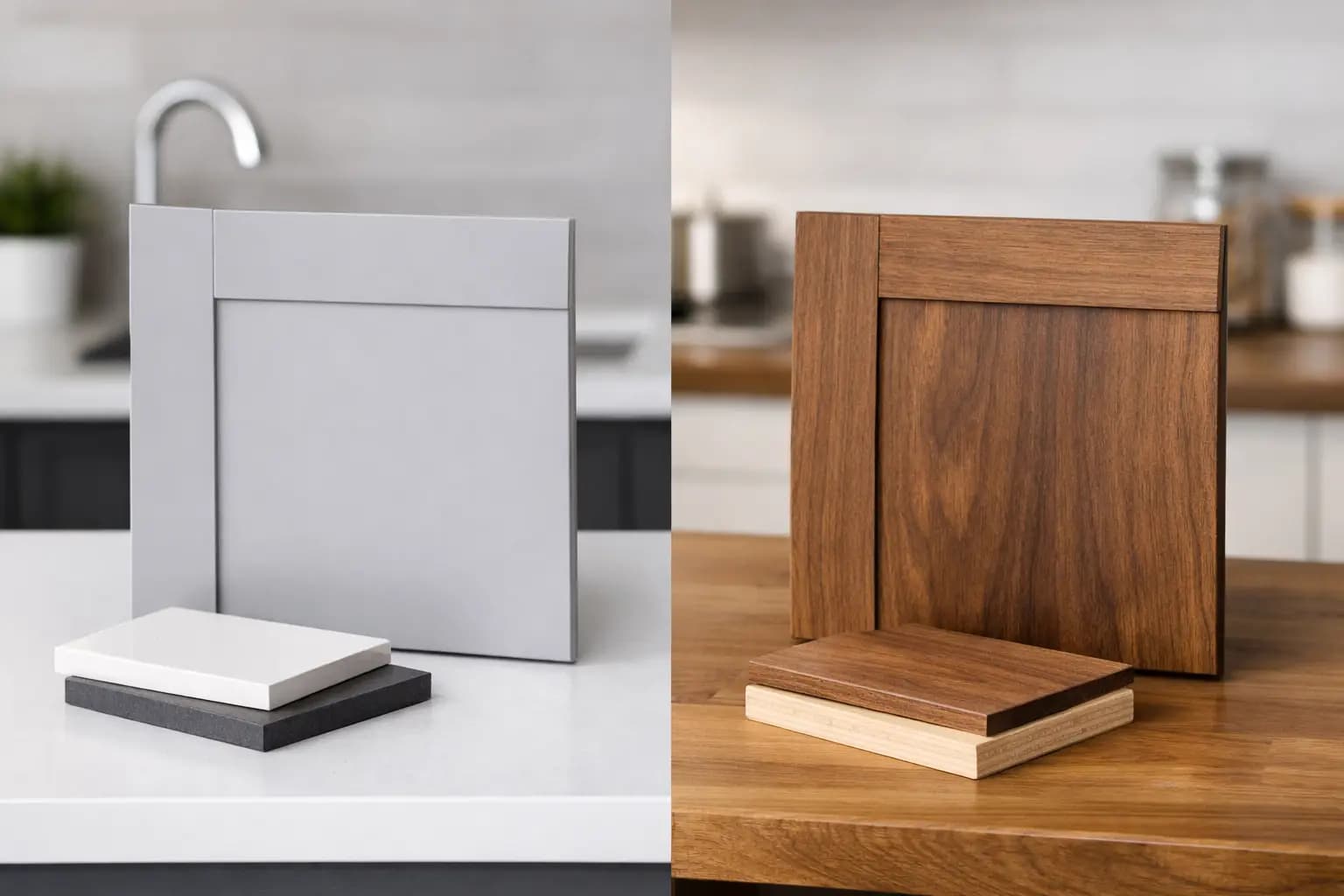
A cabinet door can look almost identical in a showroom and perform very differently after years of cooking steam, daily wiping, children’s hands, and Singapore’s humidity. The decision between laminate versus veneer cabinets is not simply about picking a finish you like. It affects the feel of your home, the level of maintenance you accept, and how confidently your carpentry will age.
For a practical family kitchen, a frequently used wardrobe, or a compact HDB layout where every built-in works hard, laminate is often the sensible choice. For homeowners who want the warmth and variation of real timber in a quieter, more tailored interior, veneer can be worth the additional care and investment. The right answer depends on where the cabinet sits, how it will be used, and what you expect from it over time.
Laminate versus veneer cabinets: the essential difference
Laminate is a manufactured decorative surface bonded onto a cabinet substrate, commonly plywood or another engineered board. It comes in a broad range of colors, textures, wood-grain patterns, stone looks, and matte or glossy finishes. Quality laminates can be highly convincing, but their most useful quality is consistency: every cabinet front can carry the same tone and pattern.
Veneer is a thin layer of real wood applied to a substrate. Because it is genuine timber, each sheet has its own grain, knots, and tonal shifts. It is typically finished with a protective coating such as lacquer, polyurethane, or oil, depending on the intended look and level of protection.
That distinction changes the visual result. Laminate delivers controlled, repeatable design. Veneer delivers natural character. Neither is automatically more premium in every setting. A well-selected laminate, precisely edged and carefully installed, can look refined and wear exceptionally well. A poorly matched or lightly protected veneer may not suit a high-abuse area, however beautiful it appears on day one.
When laminate is the practical choice
Laminate is often selected for kitchens, utility cabinets, children’s rooms, rental properties, and busy family homes because it is durable and straightforward to maintain. Its non-porous surface handles routine splashes, food marks, and fingerprints better than many natural finishes. Most day-to-day cleaning requires only a soft cloth, mild soap, and water.
It is also a strong option when you want a specific color scheme. Warm taupe, soft gray, off-white, charcoal, and textured wood-look surfaces can be repeated across a large bank of cabinetry without the natural variation that comes with timber. In small apartments, this consistency can make a kitchen or wardrobe wall feel calmer and more visually organized.
Cost predictability is another advantage. Laminate generally costs less than veneer, particularly when a project involves extensive cabinetry. That does not mean every laminate cabinet is inexpensive. The cabinet substrate, internal construction, hinges, drawer systems, edge finishing, and installation quality all affect the final price and long-term performance.
There are limits. Laminate cannot be sanded and refinished once damaged. A deep chip, lifted edge, or burn mark normally calls for repair or replacement of the affected component. Very glossy laminates may also show fingerprints more readily, while heavily textured surfaces can collect dust in their grain.
Why veneer creates a different kind of luxury
Veneer appeals to homeowners who want a material with depth rather than a printed pattern. Light moves across real wood grain differently, and no two veneer panels are exactly alike. In a living room feature wall, a study, a master suite wardrobe, or a landed-home dining cabinet, that organic variation can give a space a composed, architectural quality.
Veneer also offers greater potential for a custom finish. The wood can be stained to shift its tone, and certain finishes can be renewed when surface wear develops. Minor scratches may sometimes be touched up more discreetly than damage on a laminate surface. This makes veneer attractive for long-term homes where the owners value materials that develop character rather than remain perfectly uniform.
Its trade-off is sensitivity. Wood reacts to environmental changes, and veneer needs a stable, well-protected installation. Prolonged moisture exposure, harsh cleaners, and repeated rubbing at edges can affect its finish. Direct sunlight can also alter the color of natural wood over time. In humid conditions, careful fabrication, proper sealing, and appropriate use are essential.
For this reason, veneer is often best used where it can be appreciated without being constantly exposed to water, grease, or hard impact. A veneer island panel or dry-pantry cabinet may be an excellent choice; cabinetry directly beside a heavily used sink may call for a more resilient surface.
Appearance: uniform design or natural variation?
The visual question is less about whether laminate can imitate wood and more about the atmosphere you want to create. Laminate suits clean-lined contemporary interiors, Scandinavian-inspired palettes, modern classic kitchens, and projects that rely on a precise color story. It can also achieve looks that real wood cannot, from smooth solid colors to concrete-inspired finishes.
Veneer is particularly effective when the grain direction, panel proportions, and book-matching are considered from the start. A carpenter can align the grain across adjacent doors or create symmetrical patterns for a more intentional result. These details are not incidental. They are part of what makes veneer cabinetry feel bespoke.
If you prefer perfection and visual consistency, laminate may feel more reassuring. If you enjoy the slight shifts in grain and tone that make a material feel individual, veneer may be the better fit. Requesting physical samples is useful, but reviewing a larger veneer board is even better. A small swatch cannot fully show how the grain will read across a full-height wardrobe or a wide TV console.
Durability depends on construction, not surface alone
A common mistake is to compare only the cabinet-facing material. Cabinet longevity also depends on the board used, how the edges are sealed, whether wet areas are properly detailed, and the quality of the hardware.
For kitchens and bathrooms, moisture management matters as much as material selection. Water that repeatedly reaches unsealed edges, sink cutouts, or cabinet bases can damage the substrate beneath either laminate or veneer. A thoughtful design includes practical clearances, appropriate edging, durable internal finishes, and hardware that keeps doors and drawers aligned.
At Carpenters 匠, in-house carpentry allows these material decisions to be coordinated with the cabinet construction rather than treated as a surface-level choice. That matters when a design includes mixed finishes, such as laminate interiors and kitchen doors with veneer feature panels. The finished result should look intentional while remaining suitable for the way the room is used.
How maintenance differs
Laminate asks for simple, regular care. Wipe spills promptly, avoid abrasive scouring pads, and do not leave standing water at joints or edges. Strong solvents and aggressive cleaners can dull the surface or compromise edging over time.
Veneer needs a gentler approach. Use a lightly damp, soft cloth and dry the surface afterward. Avoid harsh chemical cleaners and excess moisture. Depending on the finish, periodic professional maintenance or refinishing may be appropriate years down the line, especially for cabinets in sunny rooms or high-contact areas.
Neither material benefits from being treated like a countertop. Do not cut directly on cabinet surfaces, place hot cookware against doors, or allow wet towels to sit against cabinet edges. Good daily habits protect the construction beneath the finish as well as the finish itself.
A smart way to choose for each room
You do not have to use one finish throughout the home. Many well-planned interiors use laminate where resilience is the priority and veneer where material warmth is most visible. A family kitchen may use easy-care laminate doors, while the adjoining dining sideboard carries a walnut veneer finish. A wardrobe exterior may be veneer, with durable laminate on internal shelving and drawers.
Before confirming a selection, consider the room’s moisture level, sunlight, frequency of use, cleaning routine, and the visual role of the cabinet. Also ask how the edges will be finished, what substrate is proposed, and how the material sample will relate to the final panel size. These questions are often more revealing than a broad label such as “premium” or “water-resistant.”
The best cabinet finish is the one that supports the life you actually live: laminate for calm, hardworking consistency; veneer for natural warmth and crafted presence. Let the material earn its place in the room, and your cabinetry will feel considered long after the renovation is complete.
Table of Contents
You Might Also Like
Platform Bed Design Singapore: Storage Beds and Headboard Planning
OCT 31, 2026
Bungalow Interior Design Singapore: Planning Large Homes
OCT 30, 2026
Condo Living Room Design Singapore: Layouts for Entertaining
OCT 29, 2026
BTO Renovation Sequence Singapore: What to Do First
OCT 28, 2026
HDB Maisonette Renovation Singapore: Designing Two Levels
OCT 27, 2026
Meeting Room Design Singapore: Layouts, Acoustics and Technology
OCT 26, 2026
Quartz vs Solid Surface Countertop Singapore: Which to Pick?
OCT 25, 2026

Interior Designer vs Contractor Singapore: Key Differences
OCT 23, 2026
Japandi Interior Design Singapore: Warm Minimalism for Homes
OCT 22, 2026
Nursery Design Singapore: Planning a Safe and Practical Baby Room
OCT 21, 2026
Shoe Cabinet Design Singapore: Storage for Every Household
OCT 20, 2026
Semi-Detached House Interior Design Singapore: Space Planning
OCT 19, 2026
Condo Bathroom Renovation Singapore: Waterproofing and Layout
OCT 18, 2026
BTO Renovation Budget Planning Singapore: Setting Priorities
OCT 17, 2026
Executive Apartment Renovation Singapore: Planning Large Layouts
OCT 16, 2026
Office Reception Design Singapore: Planning First Impressions
OCT 15, 2026
Vinyl Flooring Singapore: Pros, Cons and Where It Works
OCT 14, 2026
How to Choose an Interior Designer Singapore: Questions to Ask
OCT 13, 2026
Scandinavian Interior Design Singapore: Adapting to Our Climate
OCT 12, 2026
Kids Bedroom Design Singapore: Rooms That Grow with Children
OCT 11, 2026
TV Console Design Singapore: Planning Feature Walls and Cabling
OCT 10, 2026
Terrace House Renovation Singapore: Narrow and Deep Layouts
OCT 09, 2026
Condo Renovation Approval Singapore: Confirm with Management
OCT 08, 2026
BTO Defects Check Singapore: What to Inspect at Key Collection
OCT 07, 2026
2-Room HDB Renovation Singapore: Making Small Flats Work
OCT 06, 2026
Interior Design Consultation Singapore: What to Prepare
SEP 26, 2026
Kitchen Carpentry Singapore: Cabinet Planning Checklist
SEP 25, 2026
Built-In Wardrobe Singapore: Planning Storage That Works
SEP 24, 2026

Retail Interior Design Singapore: Customer Flow Planning
SEP 23, 2026
Office Interior Design Singapore: Workplace Planning Guide
SEP 22, 2026
Landed House Interior Design Singapore: Renovation Planning
SEP 21, 2026
Condo Kitchen Renovation Singapore: Layout and Storage Guide
SEP 20, 2026
Resale Flat Renovation Singapore: Family Storage Planning
SEP 19, 2026
BTO Renovation Singapore: What to Plan Before Key Collection
SEP 18, 2026
5-Room HDB Renovation Singapore: Planning Checklist
SEP 17, 2026
3-Room HDB Renovation Singapore: Space Planning Guide
SEP 16, 2026
4-Room HDB Interior Design for a Practical Family Home
SEP 16, 2026
Condo Renovation Singapore: Planning Guide
SEP 15, 2026

Commercial Fit Out Guide for Singapore Businesses
SEP 14, 2026
Why Blum Hinges Change How Cabinets Feel
SEP 12, 2026

Design Build Comparison for Better Renovations
SEP 10, 2026
10 Small Apartment Storage Examples That Work
SEP 08, 2026

Renovation Quotation Analysis Made Clear
SEP 06, 2026
How to Inspect Carpentry Quality Before Handover
SEP 04, 2026

HDB Renovation Noise Rules Guide for Homeowners
SEP 02, 2026

Office Renovation That Makes Work Flow Better
AUG 31, 2026

Renovation Permit Questions Singapore Owners Ask
AUG 29, 2026
Modular Versus Custom Cabinetry: Which Fits?
AUG 27, 2026

How to Avoid Renovation Delays in Singapore
AUG 25, 2026

Renovation Handover Checklist Guide for Homeowners
AUG 23, 2026

How Long Do Renovations Take in Singapore?
AUG 21, 2026
Laminate Versus Veneer Cabinets Compared
AUG 19, 2026

Can HDB Walls Be Removed? What to Check First
AUG 17, 2026
12 Best Storage Ideas for Families at Home
AUG 15, 2026

ID Firm Versus Contractor: Which Fits Your Renovation?
AUG 11, 2026

How to Budget Home Renovation Without Regrets
AUG 09, 2026

What Is a Renovation Deposit? A Clear Guide
AUG 07, 2026
How to Choose Cabinet Materials for Your Home
AUG 05, 2026

10 Common Renovation Budget Mistakes to Avoid
AUG 03, 2026

First Time Renovator Guide for a Confident Home
AUG 01, 2026

HDB BCA Renovation Requirements Explained
JUL 30, 2026

Retail Interior Design Singapore That Works Hard
JUL 28, 2026

Landed House Renovation Singapore Done Right
JUL 27, 2026
Small HDB Space Planning That Feels Spacious
JUL 26, 2026

3D Interior Design Visualization Singapore
JUL 25, 2026
Kitchen Cabinet Direct Factory Price Explained
JUL 24, 2026
Built In Wardrobe Singapore for Smarter Homes
JUL 23, 2026

Choosing a CaseTrust Interior Design Firm
JUL 22, 2026

How Direct Factory Pricing Shapes Renovation Value
JUL 21, 2026
Interior Design Singapore Homes That Work
JUL 19, 2026

Choose a Renovation Contractor in Singapore
JUL 18, 2026

Condo Renovation Singapore Plans That Work
JUL 17, 2026
Custom Carpentry for Singapore Homes That Works
JUL 16, 2026
HDB Renovation Plans That Make Small Homes Work
JUL 16, 2026
Designing for Hybrid Work: Flexible Offices Built for Change
JUN 11, 2026

Designing for Intergenerational Living in a 4-Room HDB Flat
JUN 11, 2026
Everyday Opulence: Functional Luxuries That Make a Big Impact in Singapore Homes
JUN 11, 2026
How to Future-Proof Your HDB for Ageing in Place
JUN 11, 2026
Mood Zones: How to Create Different Emotional Spaces at Home
JUN 11, 2026
Open-Concept HDB Design: Wall Hacking Guide
JUN 11, 2026
Quiet Please: Soundproofing Solutions for Busy Commercial Settings
JUN 11, 2026
The Art of Vertical Living: Designing Upwards in Small Singapore Spaces
JUN 11, 2026
Open-Concept HDBs: Pros and Cons
FEB 09, 2026
HDB Kitchen Hacks: Designing for the Singaporean Home Chef
FEB 09, 2026